NecroMerger - Idle Merge Game
- 4.7
- Rating
- 1.00M
- Installs
- Free
- Price

 Analysis by App-foxy
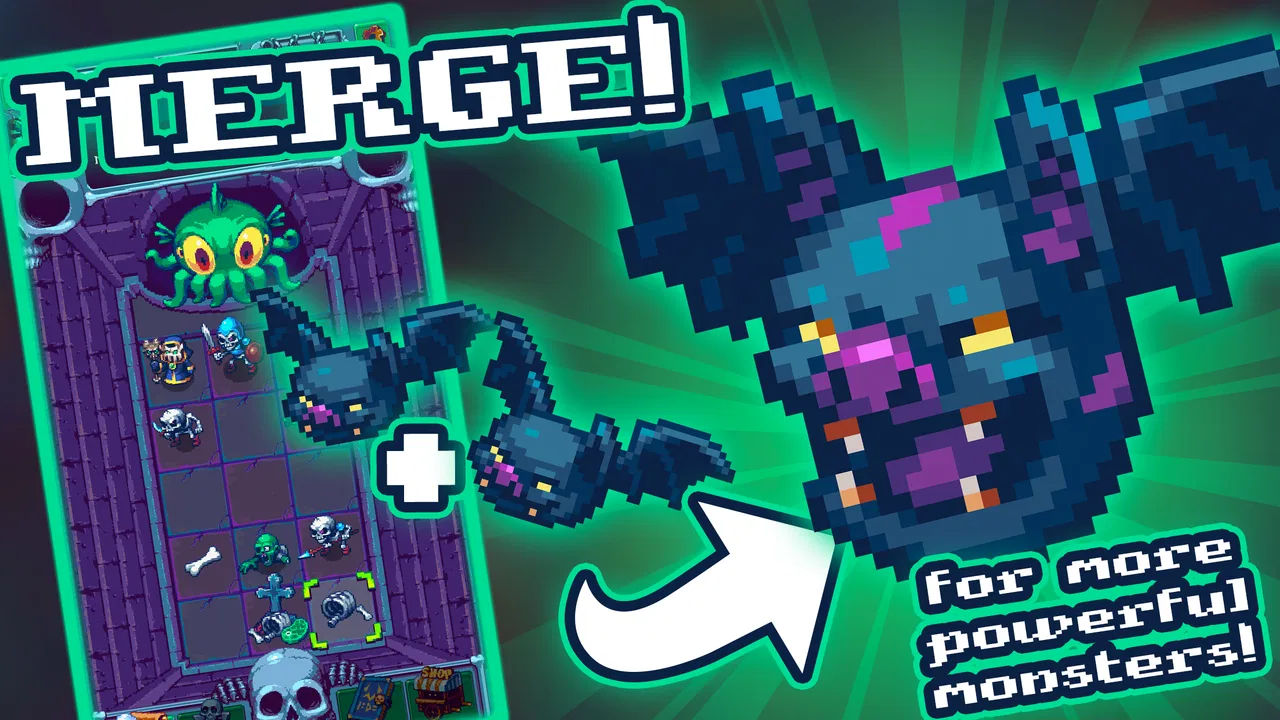
I spent time with NecroMerger - Idle Merge Game as a light simulation game, and my first impression was that it understands the appeal of small, satisfying routines. You create and combine monsters, manage a cramped-looking lair, and keep feeding the Devourer while progress continues in the background. It is not trying to be a fast action game. Its pleasure comes from checking in, making a few useful decisions, and watching a messy collection of creatures become a more productive machine.
That makes it easy to recommend to someone who enjoys idle games but wants more to do than simply tap an upgrade button. The merge system gives each visit a practical puzzle: what should I combine now, what should I keep separate, and which resource deserves attention first? At the same time, I would not call it universally relaxing. The board can become crowded, progress can feel deliberately paced, and the free-to-play structure includes optional purchases ranging from $1.99 to $99.99 per item. My experience was best when I treated it as a patient daily game rather than a title to rush through.
How the current version feels to play
The core loop is wonderfully easy to understand. Monsters appear, matching pieces are merged, and the resulting creatures help support the Devourer. The important choice is not merely whether two items can become one. It is whether merging them now improves the room or removes something useful that I may need for another task. That small layer of planning is what separates this game from a purely automatic idle app.
You May Also Like

 Blood Strike: 2.5 Anniversary
Blood Strike’s Loadouts Turn Every Drop Into a Tactical Gamble
A close look at Blood Strike’s custom loadouts: how fast access to signature weapons reshapes its battle royale rhythm, rewards preparation, and narrows the gap between fights.

 Pandora - Music & Podcasts
Pandora’s Music Is Easy to Start, but Harder to Recover
Pandora’s strength is its low-effort path from a seed to a station. Its weak spot is how much confidence it asks you to place in connection, setup, and quiet recovery.

 8 Ball Pool
 Is Built on Rivalries, Rematches, and Routine
A close look at the rivalries, rematches, shared routines, and unanswered safety questions that turn a quick pool match into a persistent mobile community.

 Samsung Music
’s Quiet Strength Is Playing What You Already Own
Its reach comes less from spectacle than from dependable access to a personal library. That simplicity is both the app’s strongest retention engine and its ceiling.

 AccuWeather: Weather Radar
AccuWeather Review: A Quick, Clear Forecast for Everyday Decisions
For everyday plans, the best forecast is the one you can understand quickly. AccuWeather makes rain timing, radar, and local conditions easy to act on, with a few trade-offs.

 Hill Climb Racing
Why Hill Climb Racing Still Turns Crashes Into One More Run
A tiny car, a bumpy hill and one more upgrade: Hill Climb Racing keeps resurfacing because its simple chaos makes every near-miss feel personal.
More From Our News Desk



I found the game most enjoyable in short sessions. I could open it while waiting for a bus, combine a few creatures, clear some space, and leave it running in the background of my day. Later, I returned to collect the results and decide what deserved the next investment. This rhythm suits people who like visible progress without needing to reserve a full evening for gaming.
The simulation label fits because the lair gradually becomes a system that needs management. A new monster is not just a collectible decoration; it affects how efficiently the whole setup develops. The Devourer gives the activity a clear purpose, while the merge mechanic keeps the screen active enough that I am making choices instead of watching numbers rise. The tone also helps. The macabre theme is playful rather than grim, so the game feels more like a cartoon laboratory than a serious horror experience.
One useful habit is to avoid merging automatically whenever a pair becomes available. I often gained more from keeping a small reserve of lower-level creatures than from immediately creating a higher-level one. That reserve gave me flexibility when the room presented another objective or when I needed to reorganize the board. It is a simple adjustment, but it prevents the common idle-game mistake of spending every resource the moment it appears.
The first hours are friendly, but the room demands discipline
Early progress is approachable because the rules become clear through repetition. I did not need a long tutorial to understand the relationship between monsters, merging, and feeding the Devourer. The challenge arrives gradually, when the available space starts to matter and every occupied spot has an opportunity cost.
That is where the game becomes more interesting than its short description suggests. A merge can solve one problem while creating another. It may produce a stronger creature but leave an awkward gap in the chain of available pieces. If I filled the lair without a plan, I spent more time rearranging than progressing. My practical advice is to keep the center of the room as open as possible and treat the edges as temporary storage. This is especially helpful during a quick check-in, when there is no time to tidy everything perfectly.
The idle side is useful, but it does not remove the need for attention. Returning after a long absence can produce a gratifying burst of activity, yet the best results come from checking in often enough to prevent the room from becoming inefficient. I would compare the routine to tending a small digital garden: neglect is not disastrous, but regular visits make the system feel smoother.
What the developer’s update position tells me
Grumpy Rhino Games is the developer behind the game, and the current version is 1.80. The title was released on Aug 29, 2022, so it is not a brand-new experiment waiting to prove its basic idea. It has had time to establish its identity as a long-running idle merge game, and that matters for anyone deciding whether to build a habit around it.
The visible store response is strong: the game holds a 4.7 average from around 68 thousand ratings, with more than 5 thousand written reviews and over 1 million installs. Those figures do not tell me that every player will enjoy the pacing, but they do suggest that the central combination of merging, idle progress, and monster management has found a substantial audience.
I would interpret version 1.80 as evidence of an established product rather than a promise of a particular future feature. It is reasonable to expect a maintained game to keep receiving attention, but I would not choose it based on imagined upcoming systems. The present experience is the important part: a compact management loop, a humorous creature theme, and enough decisions to make routine check-ins worthwhile.
For someone who already played an earlier version, the practical benefit of the current build is continuity. The game feels like something designed to be revisited, not completed in a single push. Existing players are likely to value the familiar structure more than dramatic reinvention. New players, meanwhile, can enter without needing to understand a complicated backstory or a large competitive ecosystem.
How I would organize a normal day with it
A realistic routine might look like this. In the morning, I would open the lair briefly, collect what has accumulated, and avoid spending every available item immediately. During a lunch break, I would use the stored pieces to complete a sensible merge chain and clear the most inconvenient spaces. In the evening, I would make the larger decisions: which creature line deserves room, whether a merge helps the Devourer, and which resources should remain untouched for the next visit.
This approach works better than opening the game repeatedly without a goal. The title rewards a little preparation. If I know I will be away for several hours, I can leave the room in a state that will be easy to process later instead of creating a cluttered collection of half-finished decisions.
Another useful trade-off is choosing between immediate convenience and long-term efficiency. A quick merge may make the board look cleaner, which feels good, but holding pieces can preserve options. I usually favor flexibility when I am unsure. The game is forgiving enough to experiment, yet the limited room means careless choices can slow the next few sessions.
That is also why I would not recommend playing it as a conventional marathon game. If I tried to force constant progress, the waiting periods became more noticeable and the simple decisions started to feel repetitive. When I accepted the idle rhythm, the same pauses felt intentional. This is a game for people who enjoy returning to a project, not for players who need a new event every few minutes.
Where it differs from familiar idle alternatives
Compared with a standard clicker, the merge board gives me more control over the shape of progress. In a clicker, the best action is often obvious: tap, buy, repeat. Here, the order of merges and the use of space can matter just as much as the amount of currency available. That makes the game more engaging for players who want a small planning layer.
Compared with a traditional city-building simulation, it is much lighter. I am not laying out roads, balancing a large population, or managing a detailed economy. The lair is a focused puzzle space, and the monster theme keeps the decisions readable. If I wanted deep construction tools or a broad sandbox, I would look elsewhere. If I wanted a manageable simulation that could fit into spare moments, this was a better match.
It also differs from a pure match-style puzzle game. The goal is not simply to clear a board for a high score before the session ends. Progress carries forward, the Devourer provides a continuing objective, and the idle layer means the game remains relevant when I am not actively touching the screen. That persistence is its main advantage over short, self-contained puzzle rounds.
On the other hand, players who prefer direct control may find the waiting and resource cycles less satisfying than a traditional puzzle or strategy game. There is no substitute here for patience. The title can be clever, but it is still built around gradual accumulation.
Small strategies that make the system less frustrating
My first recommendation is to think in chains rather than isolated merges. Before combining two creatures, I look at what that action might prevent. If a lower-level piece is easy to replace, merging is usually safe. If it is difficult to recreate or occupies a useful position in a developing chain, I keep it for later.
Second, I use the board as a planning surface. I separate pieces that are ready to merge from pieces I am saving, even if that creates a slightly untidy arrangement. This makes it easier to understand what I actually have and reduces accidental decisions made simply because two matching monsters are next to each other.
Third, I match the game to my available attention. When I have only a minute, I collect and make one safe merge. When I have a longer break, I reorganize the lair and consider the next sequence. This prevents the idle design from feeling like a chore and helps protect the game’s strongest quality: it can be useful in small portions.
Finally, I would set a personal boundary around purchases before becoming invested. The game is free to download and play, but optional in-app purchases can cost from $1.99 up to $99.99 per item. I did not need to spend money to understand the loop, and anyone uncomfortable with premium shortcuts should decide in advance whether optional spending belongs in their version of the experience.
Who should play it, and who should skip it
I think it is a strong fit for someone who likes idle simulation games with a little organization and planning. It is also suitable for players who enjoy unusual themes but do not want a demanding horror game. The Everyone content rating makes it broadly approachable, although individual comfort with cartoon monsters and a Devourer-themed premise will naturally vary.
It is a particularly good choice for a person who checks a phone throughout the day. The game gives those small openings a purpose without demanding constant concentration. It also works for players who like collecting and improving a system over time, especially when the satisfaction comes from making a messy setup more efficient.
I would skip it if I need fast action, a strong story campaign, or a clear finish line. I would also be cautious if repetitive resource loops quickly irritate me. The game’s charm depends on accepting that progress is incremental. Someone who dislikes waiting, board management, or optional purchase prompts may have a better time with a premium puzzle game that offers a fixed experience instead.
Device compatibility is reasonably broad: the current release supports Android 7.0 and later. The game is free, which makes trying it straightforward, but the free entry should not be confused with a completely frictionless experience. The most comfortable players will be those who enjoy the basic loop on its own and view purchases as optional rather than necessary.
What I would watch as the game continues
The most important thing for the future is balance. As an idle game grows, new layers can either add meaningful choices or turn a clean routine into a crowded checklist. I would like the developer to preserve the clarity of the merge board and avoid making every return feel like administrative work.
I would also pay attention to how the game treats long-term players. The current structure is strongest when it gives veterans reasons to plan without making newcomers feel lost. Any future changes should ideally respect both groups: established players need worthwhile goals, while first-time players need a readable path into the lair.
For now, the current version offers enough substance to justify a trial without requiring a purchase. My expectation is not that every session will be exciting. Instead, I see it as a dependable background game with occasional moments of satisfying optimization. That is a narrower promise than a full strategy title, but it is one the game generally understands.
After playing it, my recommendation is simple: try it if you want a monster-themed idle game where merging and room management matter. Start slowly, keep some pieces in reserve, and do not judge the experience by the first few minutes alone. Its best qualities appear once the lair becomes a system you recognize and can improve.
My final verdict: this is a polished, approachable choice for patient players who enjoy incremental progress with light strategic decisions. It is not the right replacement for an action game or a deep simulation, and the pacing will test anyone who wants immediate rewards. But if you like checking in, making a few smart merges, and feeding a wonderfully odd digital creature over time, NecroMerger earns a place on my home screen.
FAQs for NecroMerger - Idle Merge Game
01What is NecroMerger – Idle Merge Game about?
NecroMerger is a humorous idle management game where you play a powerful necromancer building an underground lair. You summon creatures, merge matching monsters to create stronger versions, feed them to your NecroMerger, and expand your dungeon. The game combines merge puzzles, resource management, light strategy, and incremental progress, making it suitable for players who enjoy short sessions as well as longer planning sessions.
02Is NecroMerger free to download and play?
Yes, NecroMerger can be downloaded and played for free on supported Android and iOS devices. The game includes optional in-app purchases, which may provide premium currency, bundles, or convenience items. Progress is not based solely on spending, but free players may need more patience when waiting for resources, completing timers, or unlocking certain upgrades. It is worth checking the store listing for current pricing and device requirements.
03Does NecroMerger require an internet connection?
NecroMerger is primarily designed as an idle game, so some features and progress systems may work during short offline periods. However, an internet connection can be required for advertisements, cloud-related features, account synchronization, events, updates, and purchases. Offline behavior may also vary depending on the device and game version. For the most reliable experience, connect to the internet regularly and avoid assuming that every feature works without a connection.
04Are there advertisements or in-app purchases in NecroMerger?
The game includes optional advertisements and in-app purchases. Ads may be offered as a way to obtain extra rewards, speed up certain activities, or improve resource collection without spending money. Purchases can provide premium currency, special packs, or other conveniences. Players who prefer a completely uninterrupted experience should review the available options carefully, while free-to-play users can generally make progress by managing resources and playing consistently.
05Is NecroMerger suitable for children and casual players?
NecroMerger is easy to learn and works well for casual players because its core actions—summoning, merging, collecting, and upgrading—are introduced gradually. Its cartoon presentation and comedic writing make it approachable, although the necromancer theme includes monsters, ghosts, skeletons, and fantasy references that may not suit every young child. Parents should also consider optional advertisements, in-app purchases, and the game’s tendency to encourage frequent check-ins for idle rewards.
Pros
- Simple merge mechanics make it easy to learn and play casually.
- Runs well in short sessions when you only have a few minutes.
- Many creatures and stations give progression a satisfying sense of variety.
- Humorous writing and quirky characters add personality to the gameplay.
- Offline-friendly design lets you make progress without constant connectivity.
Cons
- Energy limits can slow progress during longer play sessions.
- Some upgrades require significant waiting or resource grinding.
- The board can become crowded as more stations and creatures unlock.
- Progress may feel repetitive once the main merge routines are familiar.
- Optional purchases can make faster advancement tempting for impatient players.

NecroMerger - Idle Merge Game
Gallery